
Dubai attracts millions of tourists every year, and one of the first questions before travelling is precisely about entry formalities. Whether you need a visa depends solely on your nationality. The United Arab Emirates applies three main entry models, and a Dubai visa does not always require an application in advance.
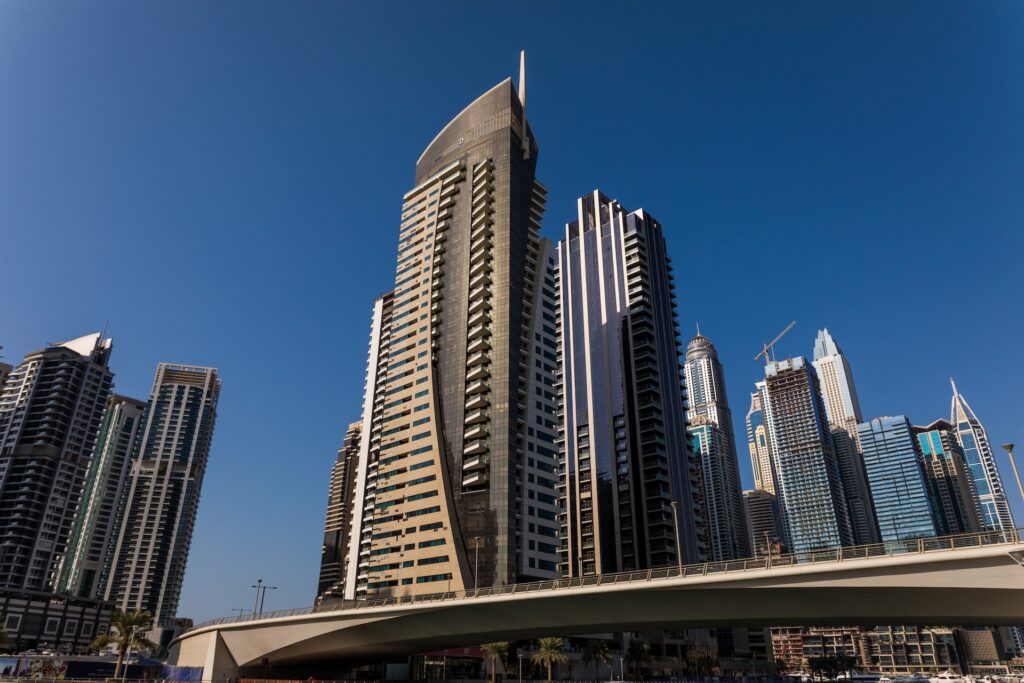
Do you need a visa for Dubai?
The first group consists of citizens of countries covered by visa-free travel arrangements. If you belong to this category, when crossing the border – at an airport or port – you receive a visa free of charge automatically, without submitting any documents in advance. Depending on your passport, the permitted period of stay is 30, 90 or even 180 days.
This includes citizens of most European countries, the USA, Canada, Australia, Japan, South Korea and Singapore.
The second group consists of travellers from countries requiring an e-visa before departure. In this case, you must submit an online application and obtain approval before boarding the plane. This applies, among others, to citizens of many countries in South Asia, Africa and parts of the Middle East.
The third category includes people who do not qualify for visa-free entry based on their passport but hold a valid residence card or residence visa from a selected country (e.g. the USA, the United Kingdom, EU countries or the Schengen Area). In such cases, they may obtain a short-term visa upon arrival, usually for an additional fee.
How can you check whether you need a visa for Dubai?
Before booking your flight, check your individual requirements on the official General Directorate of Residency and Foreigners Affairs portal: https://gdrfad.gov.ae/en or ICP Smart Services: https://icp.gov.ae/en/. The lists of countries covered by the individual categories change, so a reliable government checker is the only tool that can provide you with a definitive answer.
What types of tourist visas for Dubai are available?
A Dubai visa actually covers several types of entry permits. Each differs in terms of validity period, number of permitted entries and purpose. Here is an overview of the main options available to tourists:
| Visa type | Permitted stay | Number of entries |
| 30-day tourist visa | 30 days from entry | Single or multiple |
| 60-day tourist visa | 60 days from entry | Single or multiple |
| 48-hour transit visa | 48 hours | Single |
| 96-hour transit visa | 96 hours | Single |
| 5-year tourist visa | Multiple entries, max. 90 days per stay | Multiple |
Transit visas are intended exclusively for people changing flights in Dubai who want to briefly leave the airport. The 48-hour version does not involve a government fee, while the 96-hour version costs approximately AED 50 plus VAT.
It is worth remembering that a Dubai visa is actually a federal visa – it entitles you to travel throughout all seven emirates, not just Dubai. If you also plan to visit Abu Dhabi or Sharjah, you do not need a separate permit.
A separate category consists of residence visas, including the so-called Golden Visa. This is a long-term residence permit for investors, entrepreneurs, specialists or students; it is not a tourist visa and is governed by completely different rules. If you are interested in relocating to the UAE, look for information directly on the ICP portal.

How much does a Dubai visa cost?
Tourist visa fees vary depending on the channel through which you submit your application. The basic rate is set by the government (GDRFA for the Emirate of Dubai), but agencies, airlines and intermediary platforms add their own commissions, which is why prices vary between different sources.
Current government fees according to the GDRFA Dubai portal:
| Visa type | Government fee | VAT (5%) |
| 30 days, single entry | AED 252 | approx. AED 13 |
| 60 days, single entry | AED 352 | approx. AED 18 |
| 96-hour transit | approx. AED 50 | approx. AED 3 |
| 48-hour transit | AED 0 | – |
A service fee must also be added to this amount, depending on the chosen channel. At an authorised Amer centre, it is usually AED 80–120. Airlines and travel agencies may charge considerably more; you may come across offers where the final price for the same 30-day visa reaches AED 350–500.
Practical advice: before paying an intermediary, compare the price with the official GDRFA or ICP portal. The difference can be several times higher, while the result is identical.
Visas issued automatically at the airport under visa-free arrangements are free of charge. You do not incur any costs apart from a possible airport fee.
How to obtain a tourist visa for Dubai?
If your nationality requires you to obtain an e-visa in advance, the process is as follows:
- Check the requirements for your passport. Visit gdrfad.gov.ae or icp.gov.ae and make sure which type of visa you are eligible for. Do not rely solely on information provided by the airline; the official checker is always more up to date.
- Choose an application channel. You have three main options: directly through the government portal (GDRFA for Dubai, ICP for the other emirates), through an airline (if you are flying with, for example, Emirates or Flydubai), or through an authorised travel agency. An important nuance that many sources fail to explain: a tourist does not apply for a visa independently “to themselves”. A Dubai visa requires a sponsor – this role is fulfilled by an airline, hotel, travel agency or licensed tourism company in the UAE.
- Complete the form and attach the documents. You will find a detailed list in the next section. Make sure that the scans are in colour and legible – illegible or incomplete documents are the most common cause of delays.
- Pay for the visa. Payment is made online – by card or bank transfer, depending on the platform.
- Wait for a decision. The standard processing time is 2–4 business days with complete documents and an accredited channel. Some agencies offer an express service (even within a few hours), but this is a commercial service for an additional fee – not a government guarantee.
- Receive your electronic visa. Once approved, the visa is sent by email as a PDF file. With most e-visa procedures, there is no physical stamp in the passport at the time of issuance – the stamp is received only during border control at an airport in the UAE.
What documents are required for a visa application?
The list of required attachments is consistent regardless of the application channel:
● A colour passport photograph (white background, format compliant with ICAO requirements).
● A colour scan of the passport page containing the photograph – the passport must be valid for at least 6 months from the planned date of entry into the UAE. The document must be machine-readable; handwritten passports are not accepted.
● Confirmation of a return or onward flight reservation (round-trip ticket).
● Confirmation of accommodation for the entire stay (hotel, apartment or invitation from a UAE resident).
● Travel insurance valid in the UAE – although not always formally mandatory, it is increasingly required by visa sponsors and is strongly recommended due to the high cost of medical care in the emirates.
Citizens of selected countries may be asked to provide an additional identity document (e.g. a national ID card). The current list of such exceptions is available on the GDRFA portal.
How long does it take to obtain a Dubai visa?
The standard waiting time with complete documents submitted through an accredited channel is between 48 hours and 4 business days. The GDRFA Dubai portal states 48 hours as a service target for applications submitted through licensed travel agencies – this is not a guarantee, however, but rather an indicative benchmark.
Processing time is affected by: the completeness of the documents, the current workload of the authorities, weekends (Friday–Saturday in the UAE) and public holidays. Submit your application sufficiently in advance of your planned departure date – at least one week is a reasonable margin.

Passport validity and other entry requirements
Regardless of whether you need a visa or are entering visa-free, your passport must meet several requirements:
It must be valid for at least 6 months from the date of entry. This is an absolute requirement – with no exceptions and no possibility of negotiation at the border. It must be biometric and machine-readable. Temporary passports generally do not permit entry beyond the airport transit zone.
Every child, regardless of age, must have their own separate passport. Having a child listed in a parent’s passport is not recognised by UAE immigration authorities. If a child is travelling without both parents, prepare a notarised travel consent translated into English or Arabic.
At Dubai Airport, you may be subject to additional biometric screening – an eye scan or fingerprint scan is performed randomly. This is a routine procedure and not a reason for concern.
Extending a Dubai tourist visa
If you want to stay longer than your current visa allows, you can extend it without leaving the country. The rules applicable in 2026 are as follows.
A tourist visa can be extended a maximum of twice. Each extension adds 30 days of stay. The total period of stay on a tourist visa cannot exceed 180 days within a year (calculated over rolling 12-month periods, not calendar years).
You submit an extension application online through the GDRFA or ICP portal, or alternatively in person at an authorised Amer centre in Dubai. The government fee for one extension amounts to several hundred AED – the exact amount changes, so verify it directly at gdrfad.gov.ae before submitting the application. The application must be submitted before the current visa expires – not after its expiry.
What are the consequences of overstaying a visa?
Exceeding the permitted period of stay (so-called overstay) incurs a financial penalty of AED 50 for each day of delay. The amount is charged automatically and enforced upon departure from the country.
A longer overstay may result in a temporary ban on re-entering the UAE. In extreme cases, immigration authorities have the right to detain a traveller at the airport until the outstanding amount is settled. It is not worth taking the risk – if you see that your Dubai visa is approaching its expiry date, apply for an extension sufficiently early or plan your departure.
Frequently asked questions about a Dubai visa
Does a child need a separate Dubai visa?
Yes. Every person, regardless of age, must have their own passport and, where applicable, their own visa. There is no possibility of “adding” a child to a parent’s visa.
Does a Dubai visa allow you to visit other emirates?
Yes. The visa is essentially a UAE federal visa. It entitles you to travel throughout the country, including Abu Dhabi, Sharjah, Ajman and Ras Al Khaimah.
Can you work on a tourist visa?
No. A tourist visa does not grant the right to employment. Taking up employment requires a separate employment visa sponsored by an employer in the UAE.
What should you do if your visa application is rejected?
The visa fee is generally non-refundable. You can submit a new application after addressing any deficiencies or clarifying the reason for the refusal.
Is a tourist visa the same as a Golden Visa?
No. The Golden Visa is a multi-year residence permit intended for investors, entrepreneurs, scientists and selected specialists. A tourist visa is intended exclusively for leisure and short-term stays. These are two completely separate categories.
Do I need to print my visa?
A Dubai electronic visa (e-visa) is accepted in digital form – on a phone or tablet. However, it is worth keeping a PDF copy in case of problems with your device or internet access at the airport.
Visa requirements for the UAE change – before making a reservation, always check the current conditions on the official government portals. This is the only source that guarantees that the information is consistent with the actual requirements on the day of your trip.